Guides
How Do Canadian Insurers Pay for Mould Remediation Jobs?
Canadian insurers mould remediation jobs use provincial pricing guides, not Xactimate. Here is what a typical claim pays, line by line, and what it leaves out.
What to take away
- Most Canadian property policies exclude mould unless it flows from a covered peril such as a burst pipe, wind-driven rain or a sudden leak. A slow roof leak found months later is usually denied.
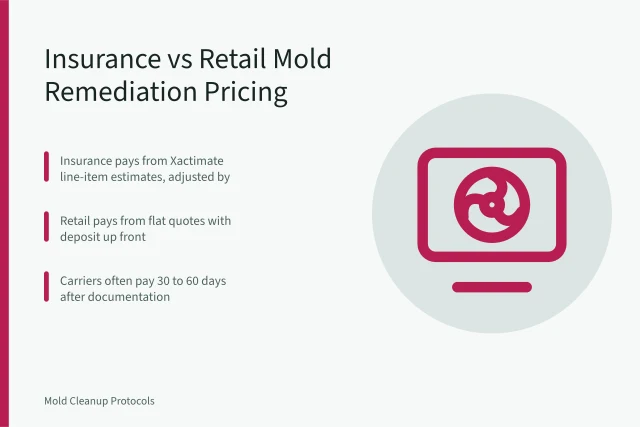
- Adjusters price the file from provincial labour and material guides, not US Xactimate rates, so your invoice has to match local unit costs.
- A typical residential claim in Ontario runs roughly $2,500 to $12,000, with large loss files in the $20,000 to $60,000 band. Treat these as illustrative ranges.
- Direct billing requires an approved vendor agreement. Without one, the homeowner pays and seeks reimbursement.
- The gap between what insurers pay and what the job truly costs sits in containment, disposal and clearance testing.
How a Canadian mould claim is actually triggered
The Financial Consumer Agency of Canada explains that home policies cover sudden and accidental water damage, and that mould resulting from a covered event is generally treated as part of that loss. That wording does the heavy lifting.
A pipe that bursts on a Tuesday and soaks a basement wall is a covered peril. The mould that follows is part of the claim. A slow drip behind a shower wall that has fed mould for two winters is a maintenance failure, and the exclusion applies.
Adjusters ask one question first: what was the peril, and when did it occur? Your file has to answer that before pricing is discussed. Photographs, a moisture map and a dated loss description carry more weight than a lab report at this stage.
Line by line: what an invoice contains
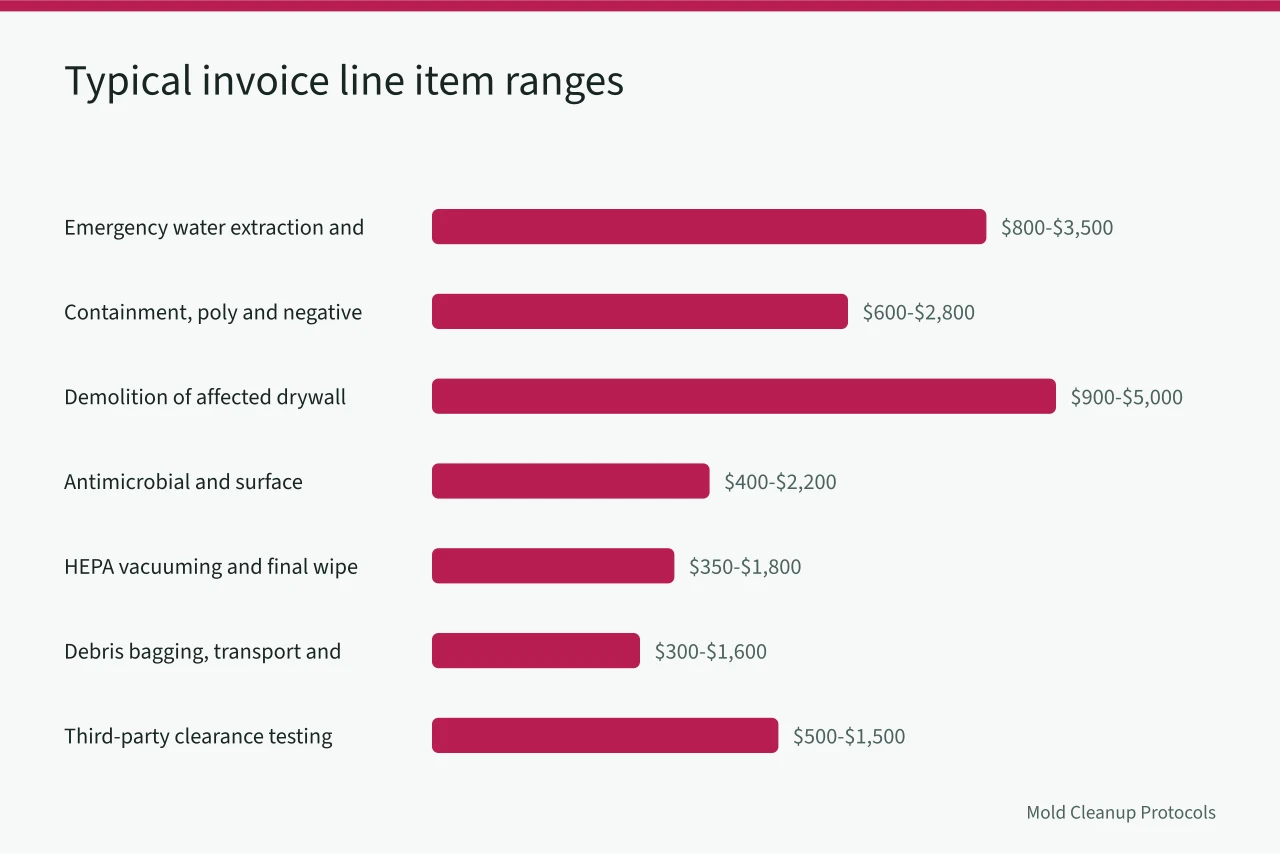
| Line item | Low | High |
|---|---|---|
| Emergency water extraction and drying | $800 | $3,500 |
| Containment, poly and negative air setup | $600 | $2,800 |
| Demolition of affected drywall and flooring | $900 | $5,000 |
| Antimicrobial and surface cleaning | $400 | $2,200 |
| HEPA vacuuming and final wipe | $350 | $1,800 |
| Debris bagging, transport and disposal | $300 | $1,600 |
| Third-party clearance testing | $500 | $1,500 |
| Supervision, documentation and reporting | $400 | $2,000 |
Those figures are illustrative for a mid-size residential loss in a major Canadian city. Commercial and institutional files scale up sharply because square footage, after-hours work and documentation demands all rise together.
A useful cross-check is the sample mould remediation quotes and the template behind them, which shows how the same job is written for an insurer and for a cash customer. The line structure is similar. The markups are not.
What moves the number
Three drivers decide most of the spread.
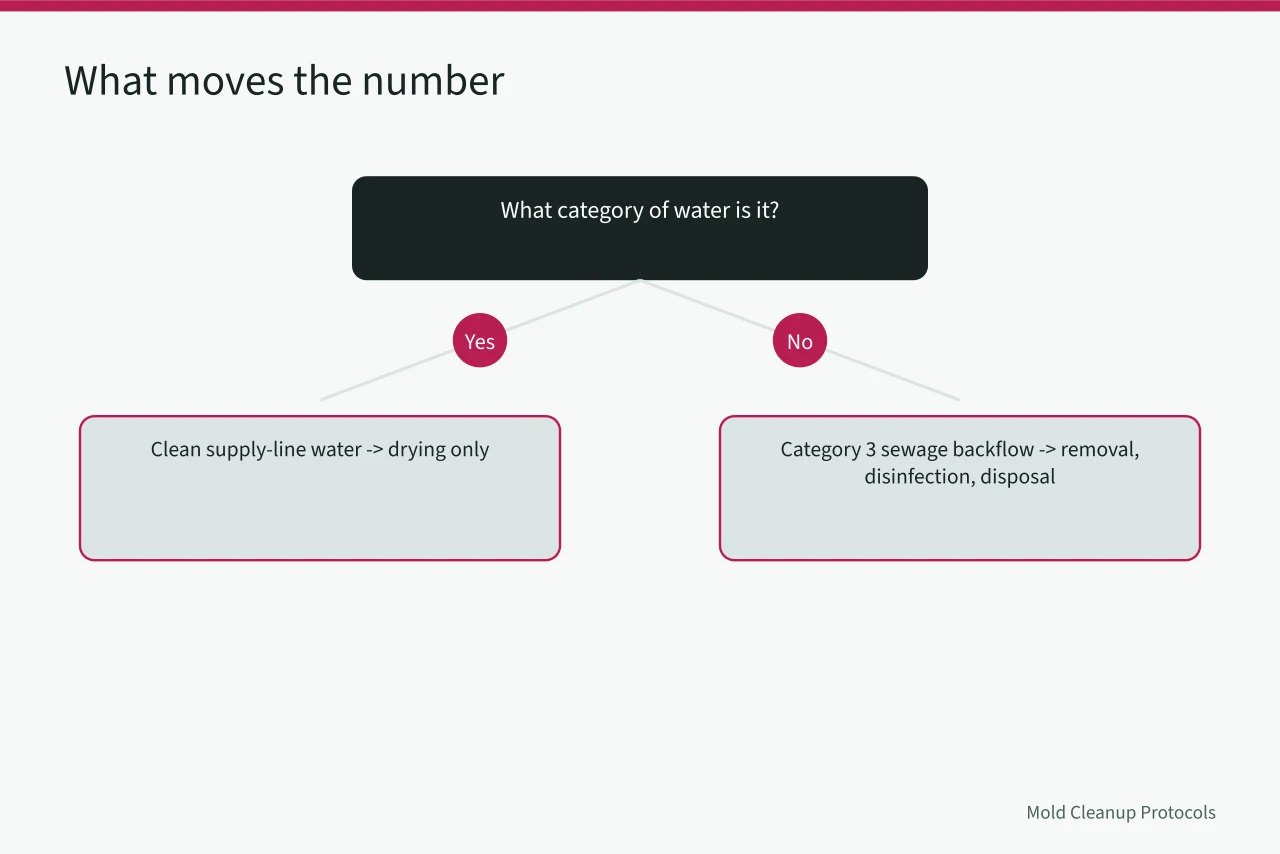
- Category of water. Clean supply-line water needs drying. Category 3 sewage backflow requires removal, disinfection and disposal, often doubling labour.
- Access and containment difficulty. A finished basement with a low ceiling and stored contents takes longer to seal than an empty mechanical room. Adjusters accept the extra hours when the photos show why.
- Clearance requirement. Where a third party must pass the space before reconstruction, testing and any failed re-clean land on the invoice. The EPA guidance for schools and commercial buildings sets out post-remediation verification principles that adjusters in Canada often reference even on residential files.
A fourth driver, less discussed, is who carries the labour burden. Respiratory protection, medical evaluation and fit testing are legal duties, not optional extras, and the OSHA respiratory protection standard is the reference most North American carriers recognise when they question a safety line. Building those hours into the estimate from the start avoids a fight later.
What quotes leave out
Most denied or reduced invoices fail on the same few omissions.
- Contents handling and pack-out, which the homeowner assumes is included.
- Disposal fees, especially where local rules treat mouldy material as restricted waste.
- Re-testing after a failed clearance.
- Reconstruction, which is a separate trade and a separate line.
- Documentation time, which is real work on every insurance file.
An adjuster cannot pay for a line that is not on the invoice. If you did the work and left it off, you donated it.
Ontario and provincial variation
Ontario mould insurance coverage follows the same peril logic as elsewhere, but the contractor side is more regulated. Ontario Regulation 278/12 under the Building Code Act sets licensing requirements for contractors, and the province maintains a searchable registry. A contractor without the right licence gives an adjuster a reason to hold the file.
Quebec adds language and workplace safety duties that change crew composition and cost. The province by province view of adjuster practice is worth reading before you price work outside your home province, because approval thresholds and documentation expectations differ more than most owners expect.
Where people overspend
Overspending on an insurance file is usually self-inflicted. Owners buy lab sampling the adjuster never asked for, then cannot bill it. They rent a larger air scrubber than the containment needs. They send a four-person crew to a job that two people can finish in the same day.
The bigger error runs the other way. Underpricing to win the vendor agreement leaves no room for the clearance failure that happens on roughly one file in ten. Build a contingency line into your rate, not into a hope.
Common questions
Does Canadian home insurance cover mould? Usually only when mould follows a covered peril such as a burst pipe or sudden water escape. Long-term seepage and poor maintenance are excluded on most policies.
Do Canadian adjusters use Xactimate? Some national carriers use it, but many rely on provincial pricing guides and regional labour rates. Ask the adjuster which guide governs the file before you submit.
Can I bill the insurer directly? Only if you hold an approved vendor agreement with that carrier. Otherwise the homeowner pays you and claims reimbursement.
How long does payment take? Payment timing is set by the carrier. Ask about the payment schedule when the file is opened rather than after the work is done.