Guides
Franchise or Independent Mold Remediation Business: Which Fits You?
Franchise vs independent mold remediation: compare FDD costs, SBA rules, and non-compete risk before you commit. Read the criteria matrix first.
What to take away
- A franchise buys brand, training, and territory, but royalties and a binding franchise disclosure document shape daily control.
- An independent start keeps margin and decision rights, but you build your own contracts, training, and referral flow.
- SBA lending rules add a filter: a franchise brand must be on the SBA Franchise Directory for certain loans.
- State non-compete law can protect or block an employee leaving a franchise, so check your state before assuming a restriction holds.
- Neither model solves the core job: defensible estimates, respirator fit testing, and clearance air sampling.
This comparison answers the question Franchise or Independent Mold Remediation Business: Which Fits You? by weighing cost, control, financing, and exit risk. Read the criteria matrix, then decide which ownership fits your local market.
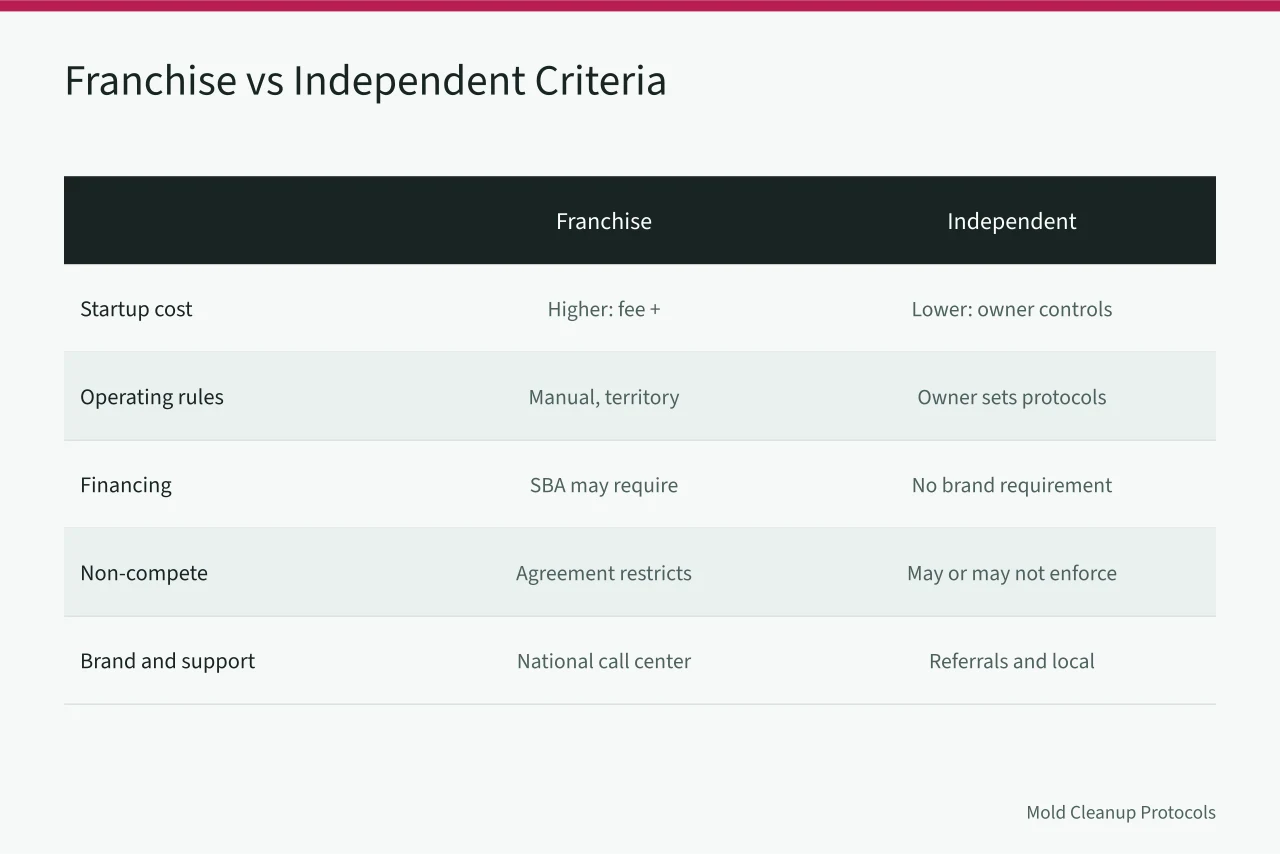
The criteria that matter
| Criterion | Franchise mold remediation | Independent mold remediation |
|---|---|---|
| Startup cost | Higher: initial franchise fee plus royalties | Lower: owner controls equipment and marketing spend |
| Operating rules | Franchisor manual, territory limits, audits | Owner sets protocols and service area |
| Financing | SBA 7(a) may require brand on SBA Franchise Directory | No franchise brand requirement; equipment loans still apply |
| Non-compete and exit | Franchise agreement restricts post-term competition | Former employer non-compete may or may not be enforceable |
| Brand and support | National call center, training, ad fund | Owner builds referral relationships and local SEO |
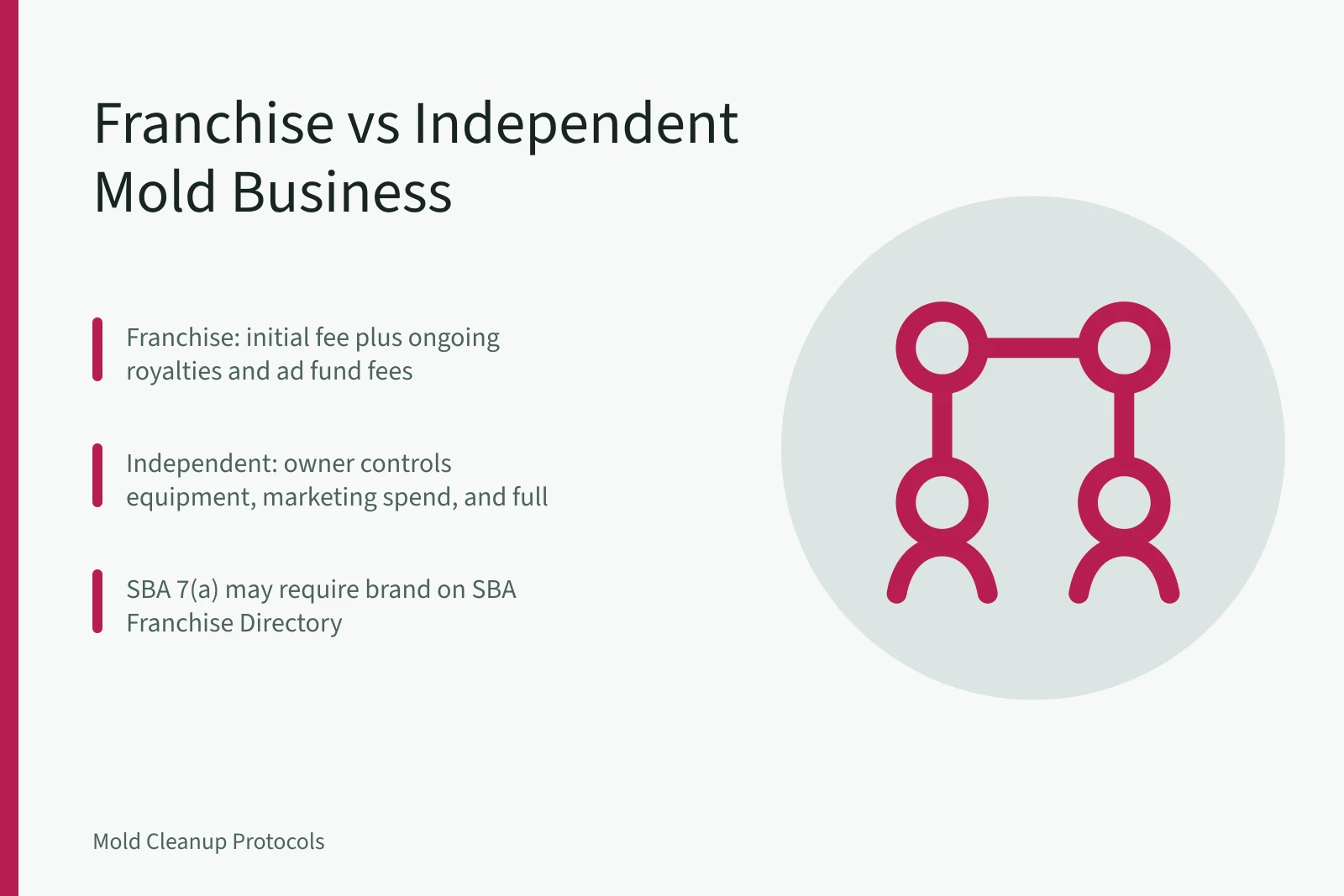
Mold remediation franchise cost is rarely just the fee. Royalties, ad fund contributions, and required equipment can shift the break-even math by territory.
- Read Items 5, 6, and 7 of the FDD for fees and initial investment.
- Check the brand on the SBA Franchise Directory if you plan to borrow.
- Ask a business attorney about non-compete enforceability in your state.
Franchise mold remediation businesses
Whether you buy a franchise or go independent, you still need to write accurate estimates, so read Xactimate Estimates before quoting a job.
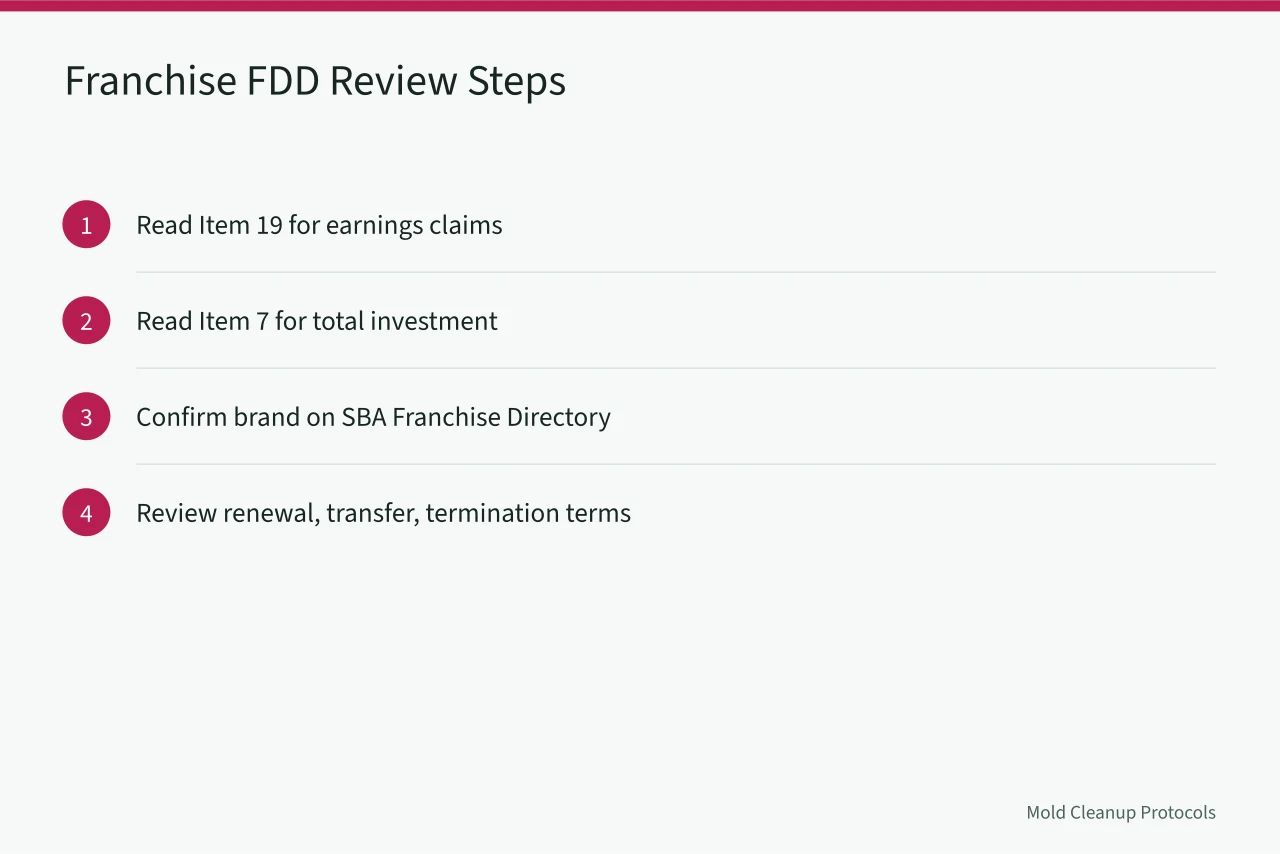
A franchise gives you a playbook, a recognized name, and a protected territory. The FTC Franchise Rule requires the franchisor to give you a franchise disclosure document before you pay. Read the FTC Franchise Rule compliance guide. Read Item 19 for earnings claims and Item 7 for total investment. Most franchise agreements include renewal, transfer, and termination terms that favor the brand.
Franchising gives brand recognition, but the agreement limits your exit and renewal options. Wikipedia explains the trade-offs of franchising. If you need an SBA 7(a) loan, confirm the brand appears on the SBA Franchise Directory. A brand missing from the directory can delay or kill that loan path.
Independent mold remediation businesses
To start an independent mold business, you control pricing, vendor choice, and hiring. You keep the full margin after job costs, but you also carry all marketing and legal risk. An independent owner must draft clear contracts, train crews, and pay for insurance without a franchisor's shared resources.
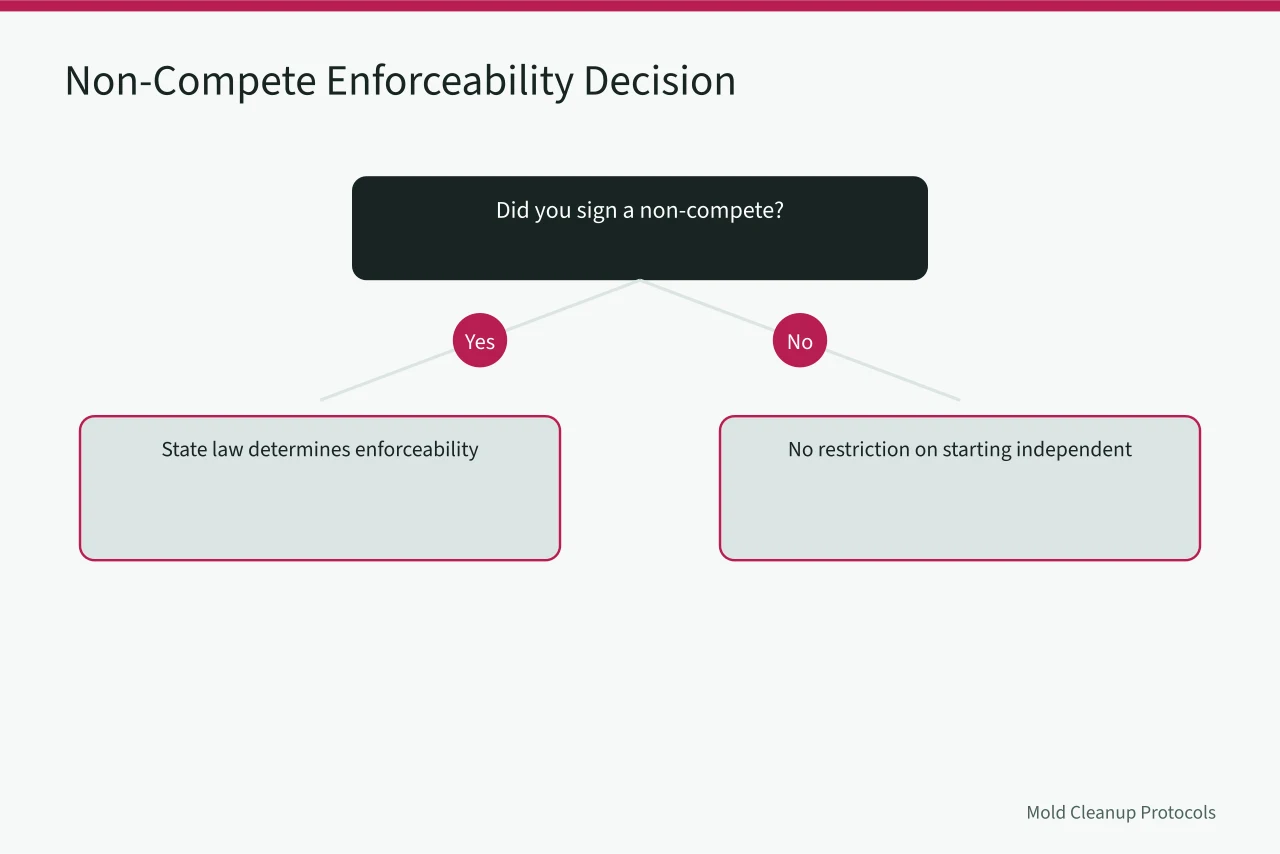
State law matters if you leave a franchise job to start your own. California generally refuses to enforce employee non-competes, while other states may enforce reasonable restrictions. Courts apply general contract law principles to non-compete clauses, and reasonableness varies by state. Cornell LII's contract overview covers the basics.
Your first hire needs training in containment, PPE, and documentation. Use business hire must learn as a starting checklist.
Where each one wins
Choose a franchise if you want a repeatable sales and production process, a protected territory, and you can accept ongoing royalties and brand audits. This is the right answer when you lack a local referral base and want corporate marketing. You will pay for that support through royalties and ad fund fees. The trade is predictable branding for less daily decision control.
Choose independent if you already have referral relationships with property managers or adjusters, want to retain every dollar of margin, and can build your own systems. This is the right answer when a non-compete is unenforceable or you never signed one.
You will also need to document every job, because no franchisor is there to supply a standard. That documentation habit matters for insurance and legal defense. A clearance standard is part of that documentation.
After you set up your independent business, read Mold Clearance Air Sampling to verify your work.
What none of them solve
Neither model removes the need for respirator fit testing. The same OSHA standard applies whether you buy a franchise or build your own crew.
Neither model removes the need for defensible contracts, clear estimates, or trained workers. The structure of ownership does not change what a mold crew must do inside a containment area.
Common questions
What does a mold remediation franchise cost? Costs vary by brand and territory. Read the FDD items 5 through 7 for initial fees, royalties, and total estimated investment.
Do I need a license to start an independent mold business? Most states do not require a mold-specific license, but some cities or states require contractor licensing and insurance. Check your state contractor board.
Can a non-compete stop me from leaving a franchise to start my own? State law varies. California generally refuses to enforce employee non-competes, while other states may enforce reasonable limits. Review the agreement with a business attorney.
Does OSHA require respirator fit testing for both models? Yes. The OSHA respiratory protection standard applies to employees required to wear respirators, whether employed by a franchise or an independent operation. Read Respirator Fit Testing for the specific steps.