Guides
How to Run Mold Clearance Air Sampling After Remediation
Mold clearance air sampling protocol: how to run post-remediation verification air samples, read results, and decide when to re-clean or call a professional.
What to take away
- Clearance air sampling is one of three verification checks, not a substitute for visual and moisture checks.
- Use an independent third party when state rules, carrier rules, or project risk require it.
- Compare each indoor sample to an outdoor reference sample, not to a single pass or fail number.
- A failed sample usually triggers a targeted re-clean, then one resample of that room.
- Stop and hand the job to an indoor environmental professional when multiple rooms fail or visible mold returns.
The mold clearance air sampling protocol starts only after the containment is clean, dry, and visually free of mold. That condition, not a date on the work order, triggers the sampling protocol. Without dry materials and a cleared visual inspection, air samples will simply confirm dust and debris in the air.
Preconditions for clearance air sampling
IICRC S520, the Standard for Professional Mold Remediation, sets three gates for post remediation verification: visual inspection, moisture content, and air sampling. AIHA guidance recommends an independent third party for clearance in many commercial settings. The first two come before you open the sample cassettes. The EPA's guidance for schools and commercial buildings describes the same order and notes that clearance air sampling should not be used alone. EPA's guidance for schools and commercial buildings
Some states and large loss carriers require third-party clearance testing, so check the contract and local rules before the remediation crew does its own sampling.
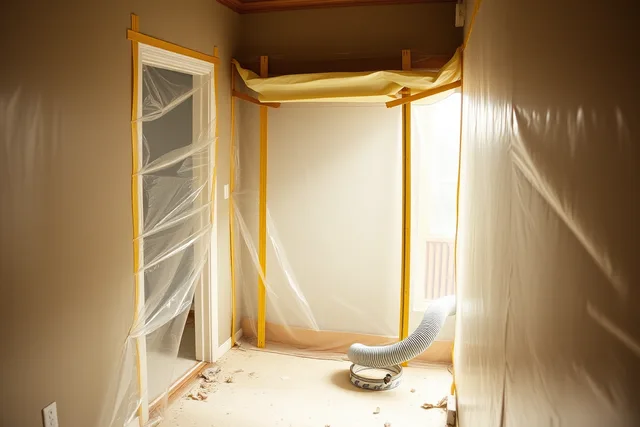
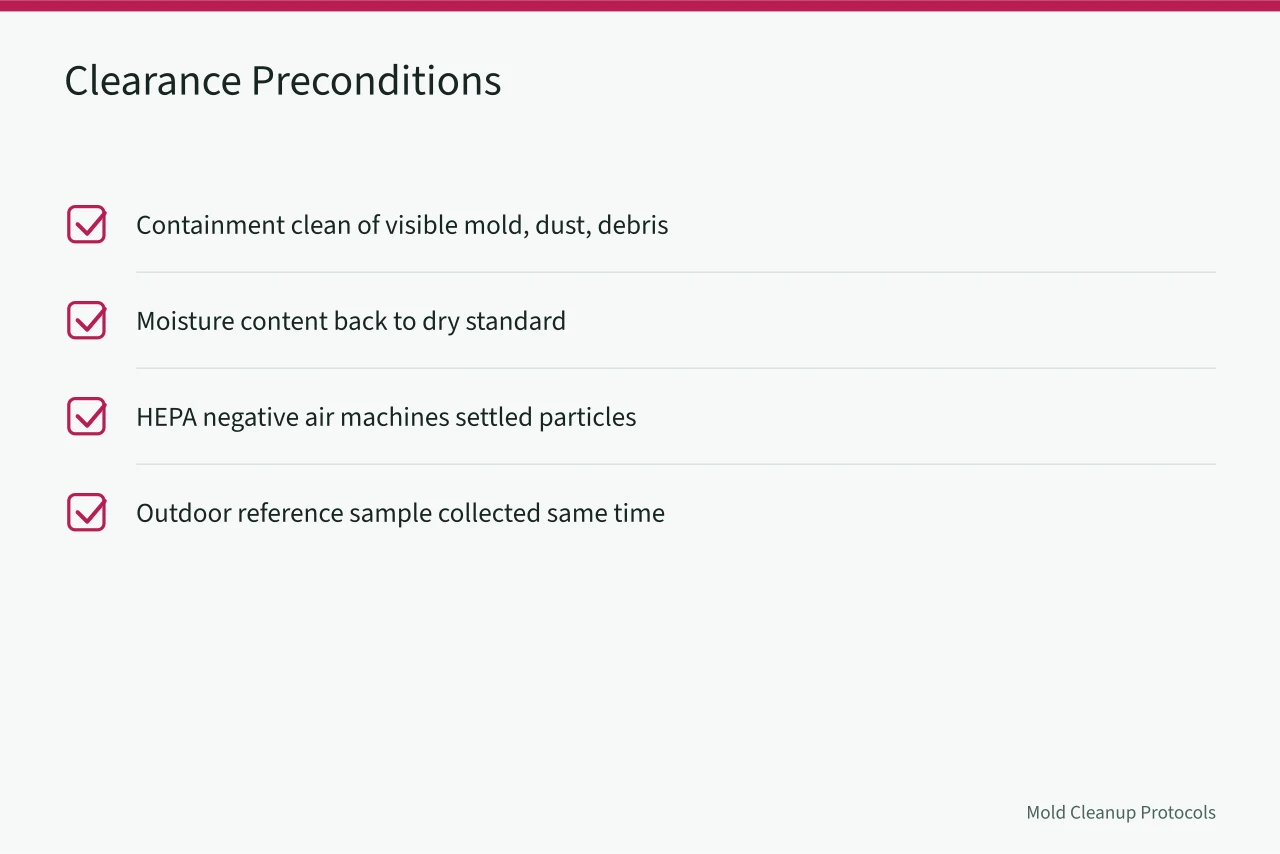
- Containment is clean of visible mold, dust, and debris.
- Moisture content of wood or drywall is back to the dry standard for the building.
- HEPA-filtered negative air machines ran long enough to settle airborne particles.
- The outdoor reference sample can be collected at the same time as the indoor samples.
A crew that skips the visual pass will produce clearance samples that fail the lab. That failure usually starts with a training gap, not a bad pump. A sampler who does not know how to seal the containment or log the pump flow rate can introduce outside air into the cassette. mold remediation business hire outlines the first-week skills that prevent this.
The sampling sequence
ASTM E3024, Standard Practice for Mold Remediation, describes air sampling methods for clearance, including the need for an outdoor reference sample. ASTM E3024
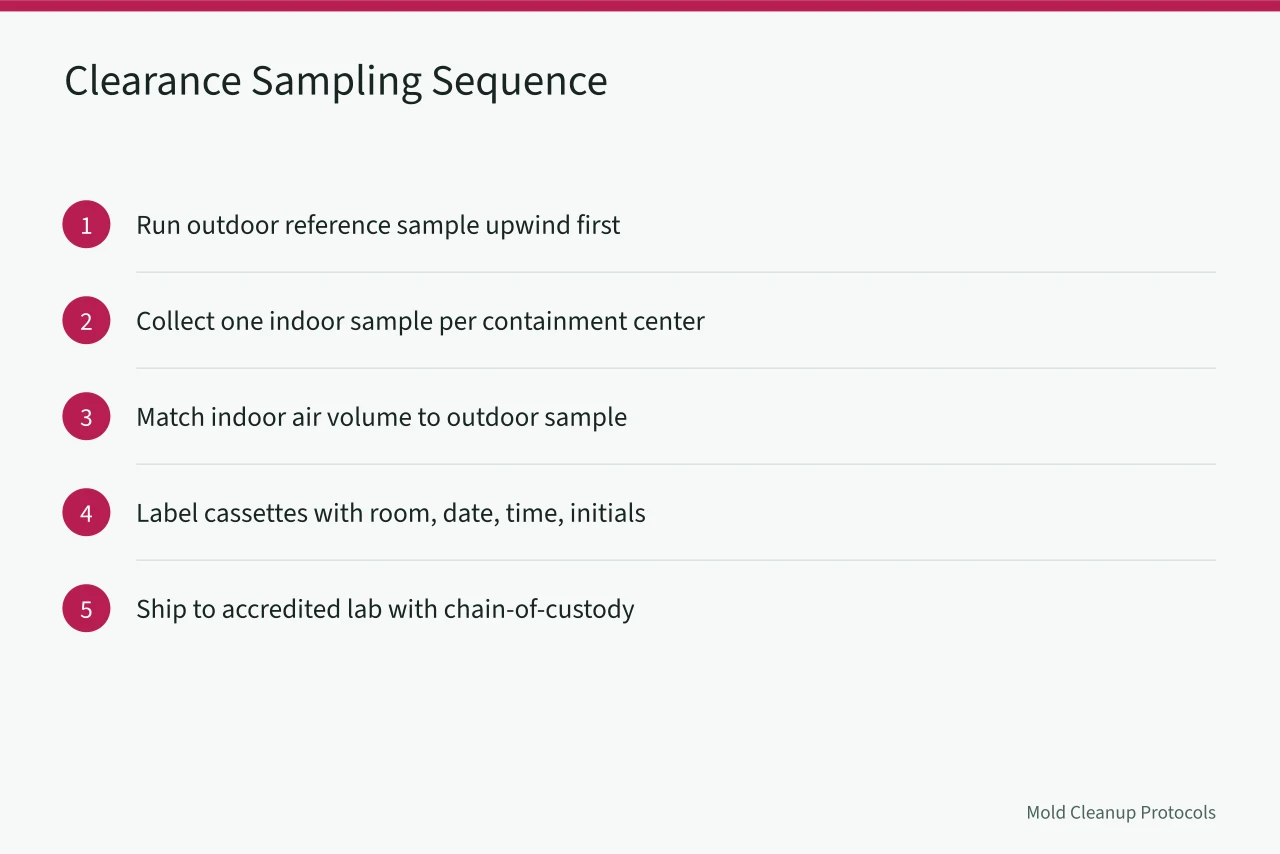
- Set up the pump and cassette outside, upwind of the building, and run the outdoor reference sample first.
- Move inside and collect one sample in the center of each cleaned containment area.
- Run each indoor sample for the same air volume as the outdoor sample.
- Label every cassette with room name, date, time, and sampler initials.
- Ship samples to an accredited lab with chain-of-custody forms.
The pass/fail decision turns on comparing each indoor sample to the outdoor reference sample, not to a single fixed number. Labs report spores per cubic meter by genus or total count. If a cleaned room shows a total spore count above the outdoor sample and the dominant genera differ from outside, the room has not passed clearance.
The step that decides the result
Clearance criteria mold remediation are not a simple threshold; they are a comparison with the outdoor air and the building's pre-loss condition. Mold air sample interpretation requires knowing both the total count and the types of spores present.
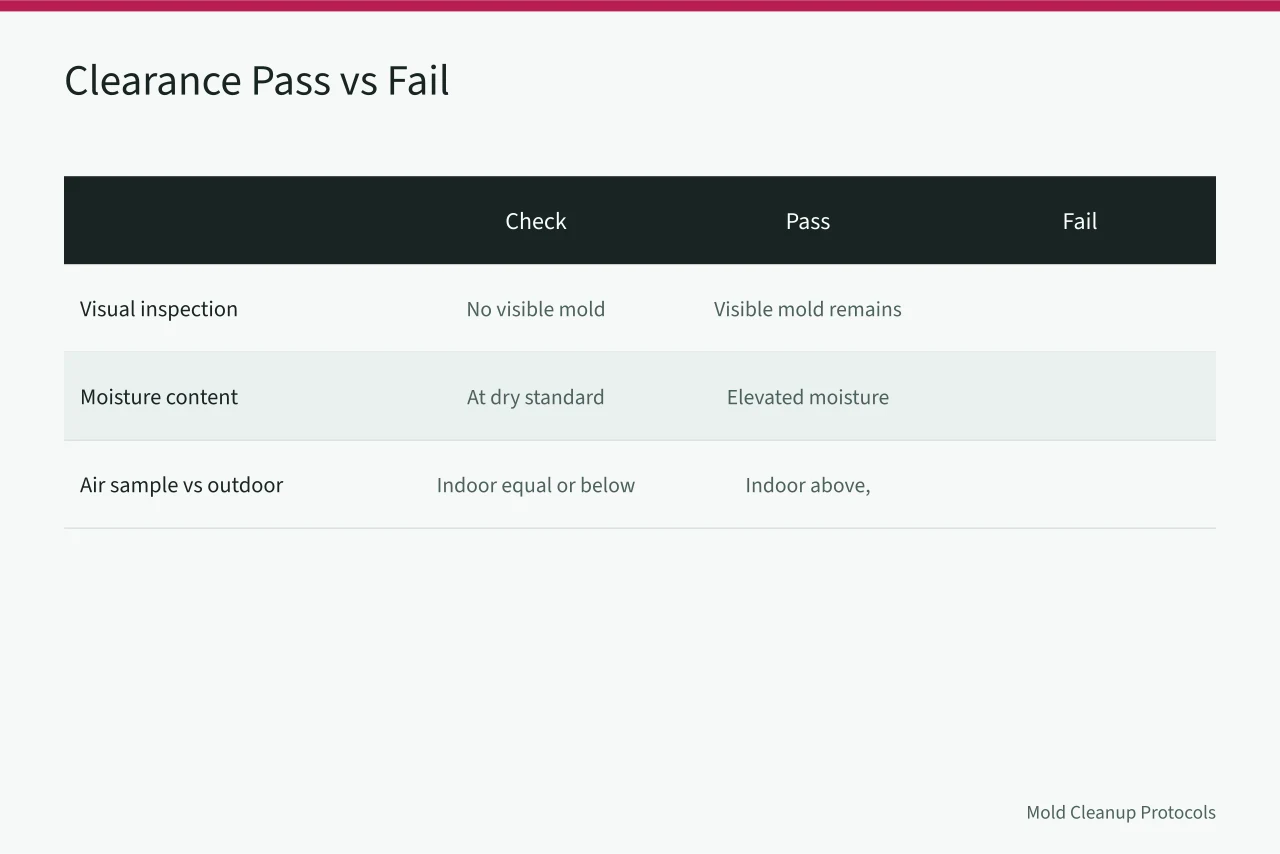
| Check | Pass | Fail |
|---|---|---|
| Visual inspection | No visible mold or dust | Any visible mold remains |
| Moisture content | Wood and drywall at dry standard | Elevated moisture persists |
| Air sample vs outdoor | Indoor total count equal to or below outdoor | Indoor count above outdoor with different spore types |
A clean clearance report is the document a property owner may show to a buyer or insurer, and it carries weight beyond the invoice. More referrals for a mold remediation business often start with a defensible clearance result.
How to check each step came out right
The EPA's mold cleanup guide for homeowners warns that air sampling alone cannot prove a mold problem is gone. Visual and moisture checks must support it.
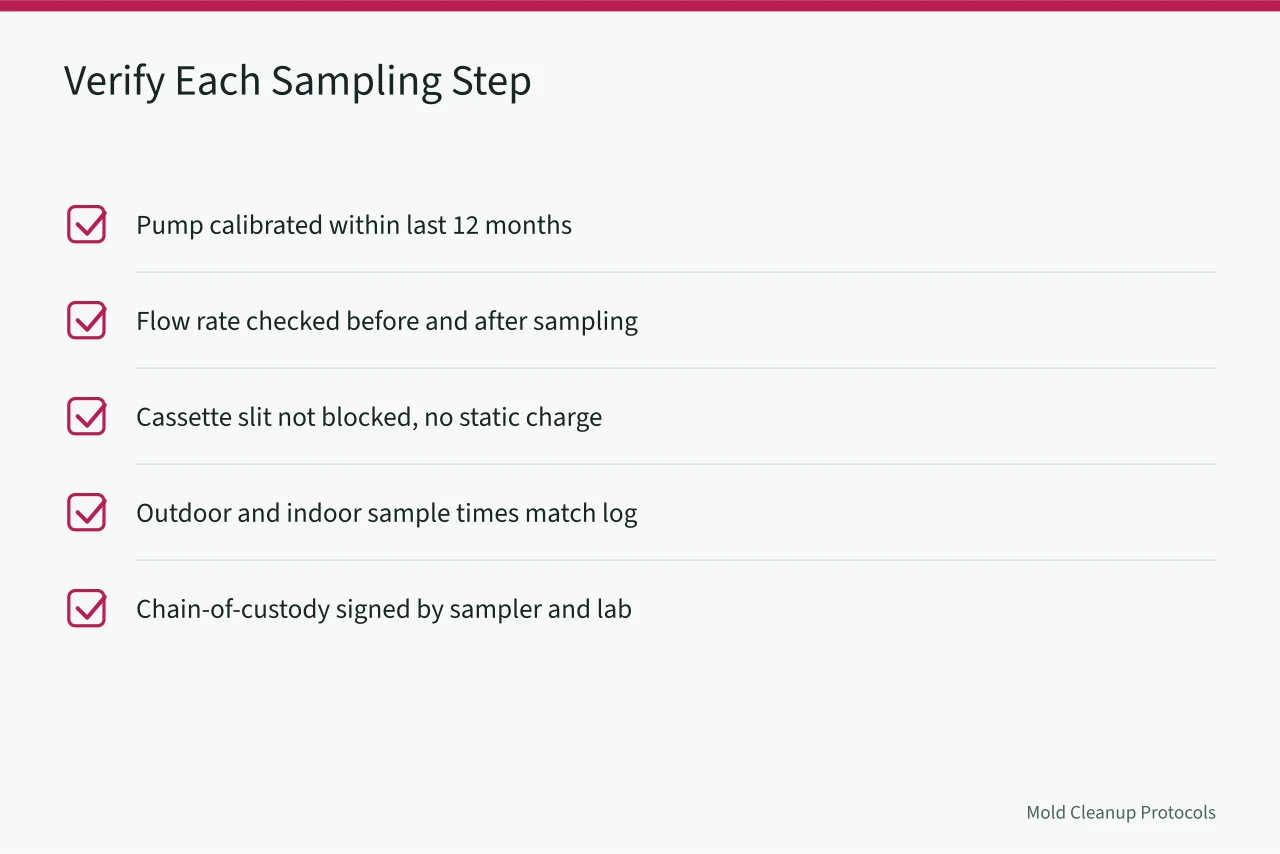
- Pump calibrated within the last 12 months and flow rate checked before and after sampling.
- Cassette slit not blocked and no static charge.
- Outdoor sample time matches indoor sample time on the log.
- Chain-of-custody form signed by the sampler and the lab receiving clerk.
A visible check on each step matters as much as the lab data. If the pump flow rate drifts more than 5 percent, the sample volume is off and the lab cannot compare rooms fairly. That is a measurable failure you can catch before the cassette leaves the site.
When a clearance fails
A single elevated sample in one room usually means a missed surface, a dust pocket, or a cassette opened too early. The named recovery is a targeted re-clean: HEPA vacuum all horizontal surfaces, damp-wipe with a detergent solution, dry, and then re-run the room sample. Do not simply run the pump longer or switch labs.
When the owner disputes the result, treat the lab report as evidence, not a verdict. Mold remediation complaint handling explains how to keep that dispute from turning into a callback.
When to stop and hand it to a professional
Stop and hire an indoor environmental professional when two or more rooms show indoor total spore counts above the outdoor reference after a targeted re-clean, or when visible mold returns in a cleaned area. That condition means the source is still wet or hidden, not that the sampling was bad.
Before you hand off, check the project's original quote to see what clearance was included. Sample mold remediation quotes show how a small operation frames that scope.
Common questions
Does clearance air sampling prove the mold is gone? No. It is one of three verification checks. Visual inspection and moisture measurement must also pass. How many air samples do I need? At least one outdoor reference and one per containment area. Large rooms may need extra samples at the lab's direction. What does a high indoor spore count mean? It means the indoor air differs from the outdoor reference. Compare spore types before deciding the room failed. When must I use a third party? When state rules, the contract, or the loss carrier requires it, and whenever the owner or insurer wants neutral documentation.