Guides
Mould Remediation Licensing in Ontario: What to Check Before You Bid
Mould remediation licensing in Ontario: no standalone licence exists. Check local permits, health unit requirements, and certified trade rules before bidding.
What to take away
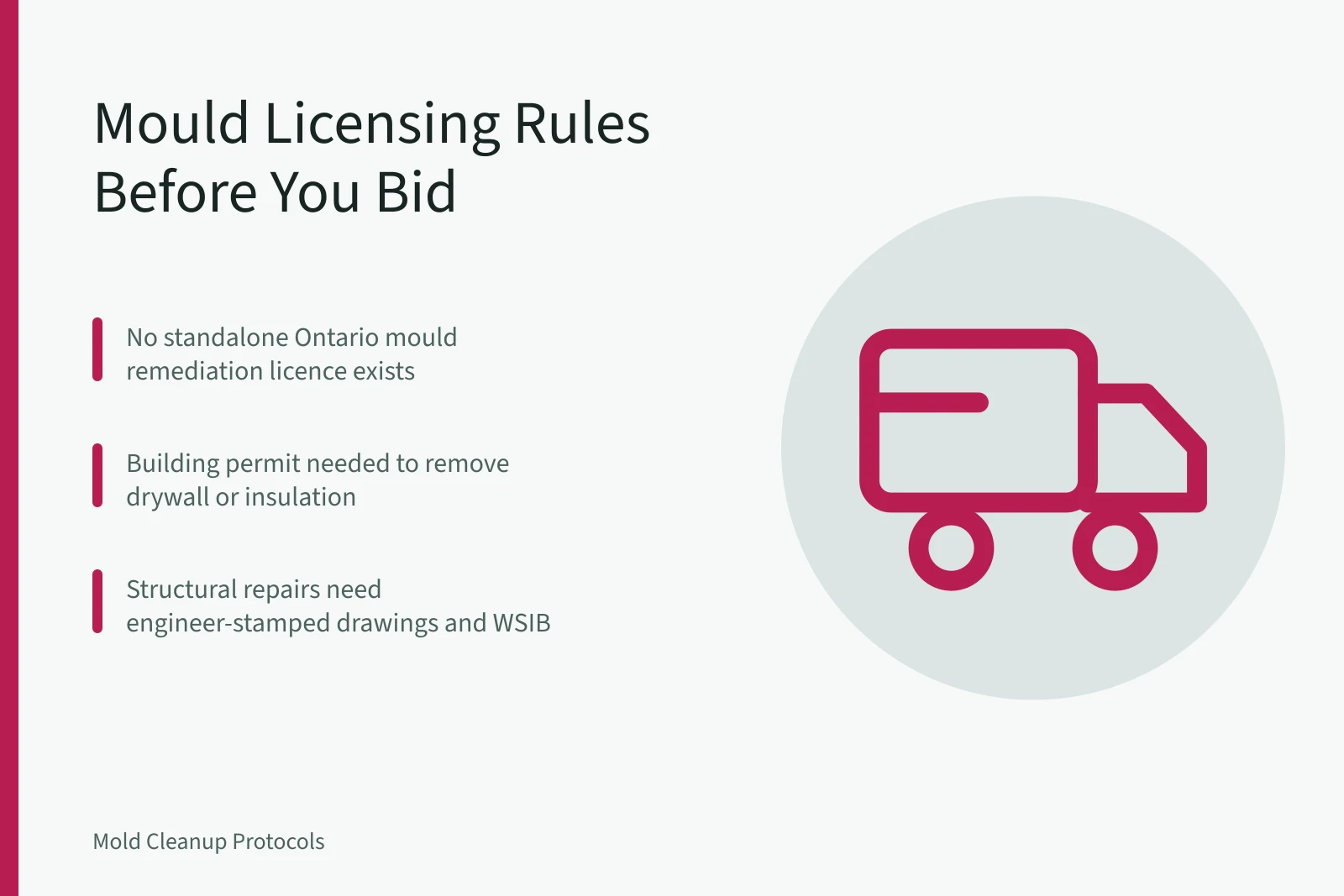
- Ontario has no standalone mould remediation licence. You check municipal permits, provincial building rules, and private certification requirements before you bid.
- A building permit is the main legal gate. Cosmetic cleaning may not need one, but structural alteration or concealed space work often does.
- Municipal building departments enforce the Building Code Act. Health units can also issue orders under separate public health powers.
- Skipping a required permit can lead to a stop work order and a correction order, not just a lost job.
Who has jurisdiction in Ontario
In Ontario, three separate layers decide whether a mould job is legal. The province sets the baseline through the Building Code Act, 1992. That Act gives municipalities the power to issue permits and inspect work. Ontario Regulation 332/12 is the current Building Code. It defines when a building permit is needed for alterations that open or change building systems.
No Ontario ministry issues a card called a mould remediation licence. There is also no separate building renovator licence for mould work. A mould remediation contractor in Ontario usually means a building permit, a municipal business licence, or a private certification such as IICRC S520. For certification details, see certifying Canadian mold remediation technicians. A public health unit can act under separate public health law, but that is not a trade licence.
What triggers a building permit
| Work scenario | Permit likely | Reason |
|---|---|---|
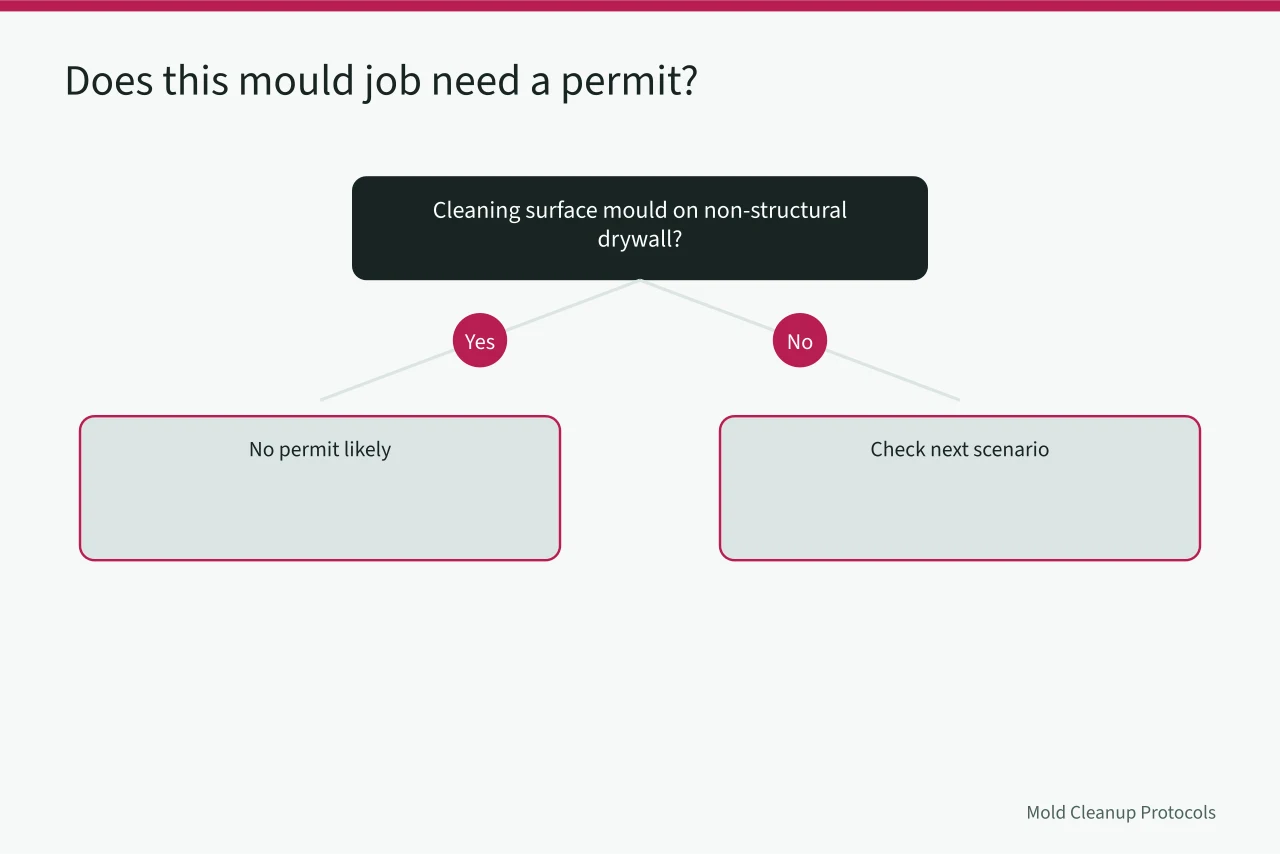
| Cleaning surface mould on non-structural drywall with no removal of finishes | No | Cosmetic work is not construction as defined by the Building Code |
| Removing and replacing drywall, insulation, or vapour barrier | Yes | Material alteration to a building system |
| Opening a wall cavity for drying and sealing it again | Yes | Building envelope work may require review |
| Structural repair of rim joists or floor framing after fungal damage | Yes | Structural design and inspection required |
The Building Code Act and Ontario Regulation 332/12 define construction broadly. A permit is usually required when you alter structure, fire separations, insulation, or plumbing. Surface disinfection alone may not trigger a permit, but local interpretation varies. Ask the local chief building official in writing before pricing the job.
What to submit with a permit application
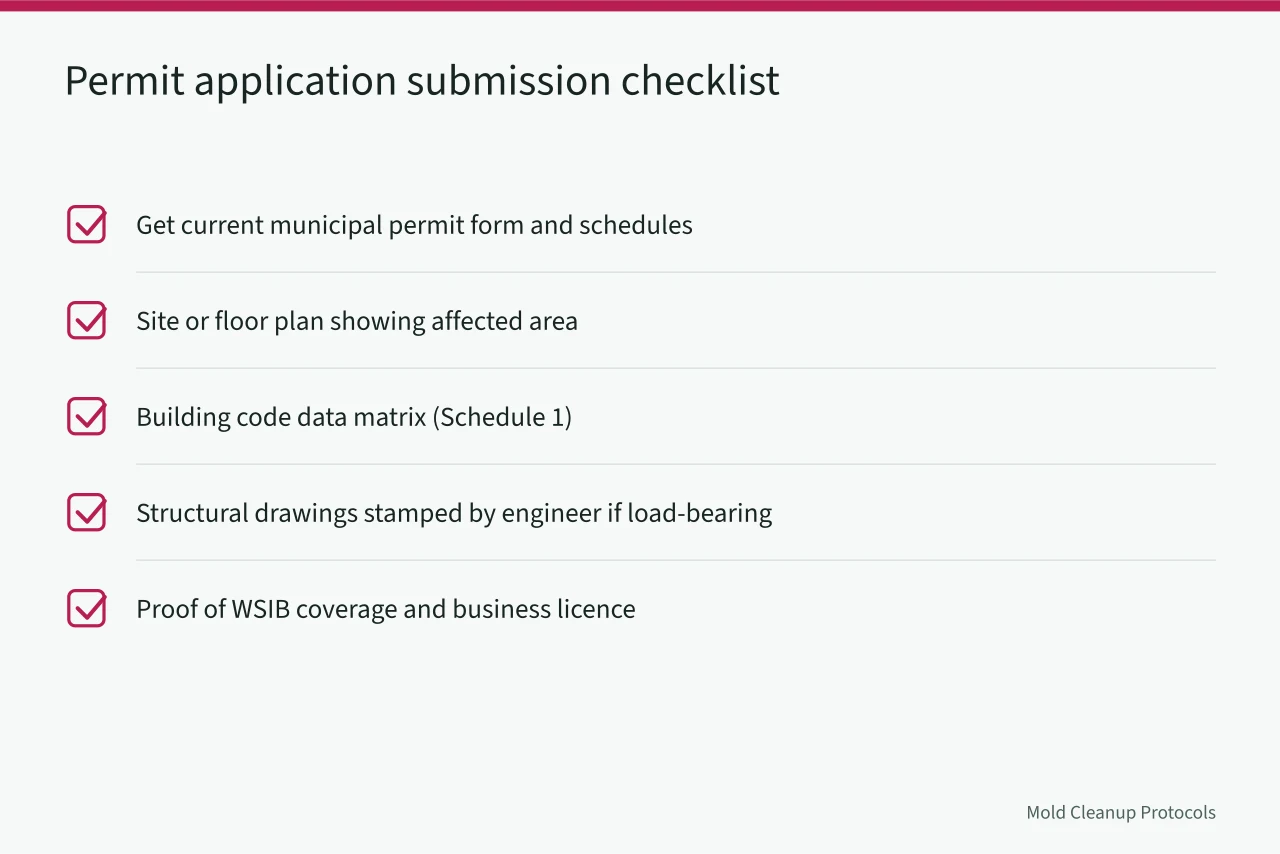
- Ask the municipal building department for its current permit application form and required schedules.
- Provide a site plan or floor plan showing the affected area, containment, and any structural members to be exposed.
- Include the building code data matrix, often called a Schedule 1 form, signed by a qualified designer if required.
- Submit structural drawings stamped by a professional engineer if the work involves load-bearing members.
- Attach proof of WSIB coverage and a valid municipal business licence if the local bylaw asks for it.
Ontario Regulation 278/12 sets out who may be a licensed builder or designer for Building Code purposes. That is not a mould-specific licence, but it can affect who signs the permit application. Your contract should also state who pays for permit fees and who signs the application. See Mold Remediation Contracts for clauses that separate those duties.
How long approval takes
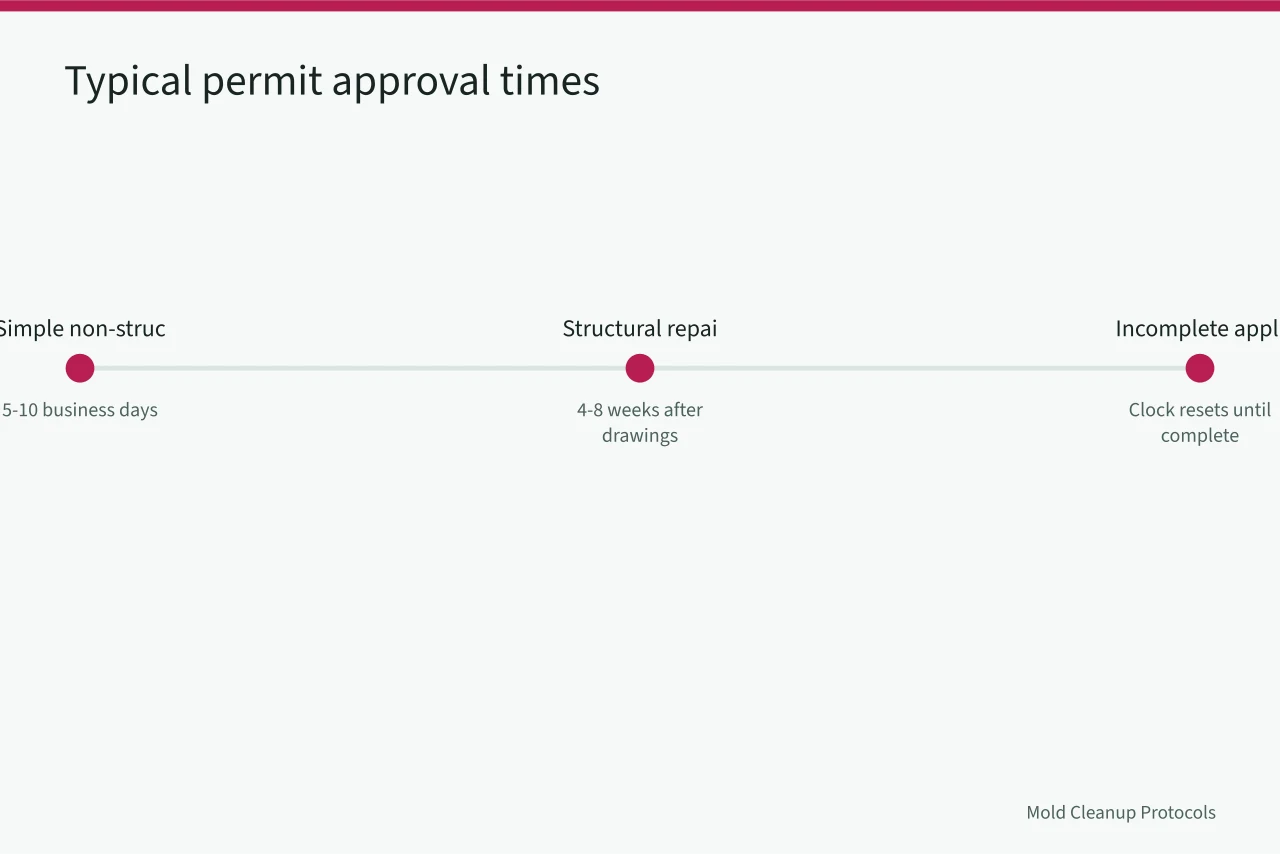
Municipal review times vary widely. A simple non-structural permit for drying and cleaning can be issued in five to ten business days in some cities. A job with structural repairs and an engineer's review can take four to eight weeks after the drawings arrive. These are illustrative ranges, not promises. An incomplete application resets the review clock. The clock does not start until the municipality says the application is complete.
Private and municipal rules that differ
Some property managers and insurers ask for technicians trained to IICRC S520. That is a private standard, not a provincial licence. Municipal property standards bylaws can require a property owner to remediate, even if no building permit is needed. Health units may inspect rental housing for mould under public health legislation, even where no building permit is required. Your contract should separate permit work from non-permit cleanup.
Before you bid, check how Canadian insurers pay for remediation jobs. Insurance coverage may exclude permit costs or require a specific scope, and that changes what you can charge and what you must submit.
What happens if you skip it
Skipping a required permit is not a minor paperwork issue. Ontario's Building Code Act lets a chief building official issue a stop work order. The official can also order you to uncover completed work or have it inspected. If you do not comply, the municipality can prosecute. A conviction can lead to fines and a court order to fix the work.
If a municipality finds work underway without a required permit, it can post a stop work order on site. The Building Code Act allows the municipality to order that the work be corrected or removed at the contractor's expense.
Common questions
Do I need a mould removal licence in Ontario? No. Ontario does not issue a standalone mould removal licence. You may need a building permit, a municipal business licence, and proof of private certification such as IICRC S520.
Does Ontario have a building renovator licence for mould removal? No. Ontario has no separate building renovator licence for mould work. The Building Code Act and Ontario Regulation 278/12 set qualifications for builders and designers who sign permit documents.
What triggers a building permit for mould work? Any work that alters structure, fire separations, insulation, or plumbing likely triggers a permit. Removing and replacing drywall or opening a wall cavity often requires one.
What happens if I skip a permit? A chief building official can issue a stop work order and require you to correct or remove work. You can face fines and a court order. Once corrected, clearance air sampling may be needed. See Mold Clearance Air Sampling.