Guides
Insurance versus Retail Mold Remediation Pricing: What Differs
Insurance retail mold remediation pricing splits into two models: Xactimate and adjuster negotiation versus flat retail quotes. Here is how each one pays.
What to take away
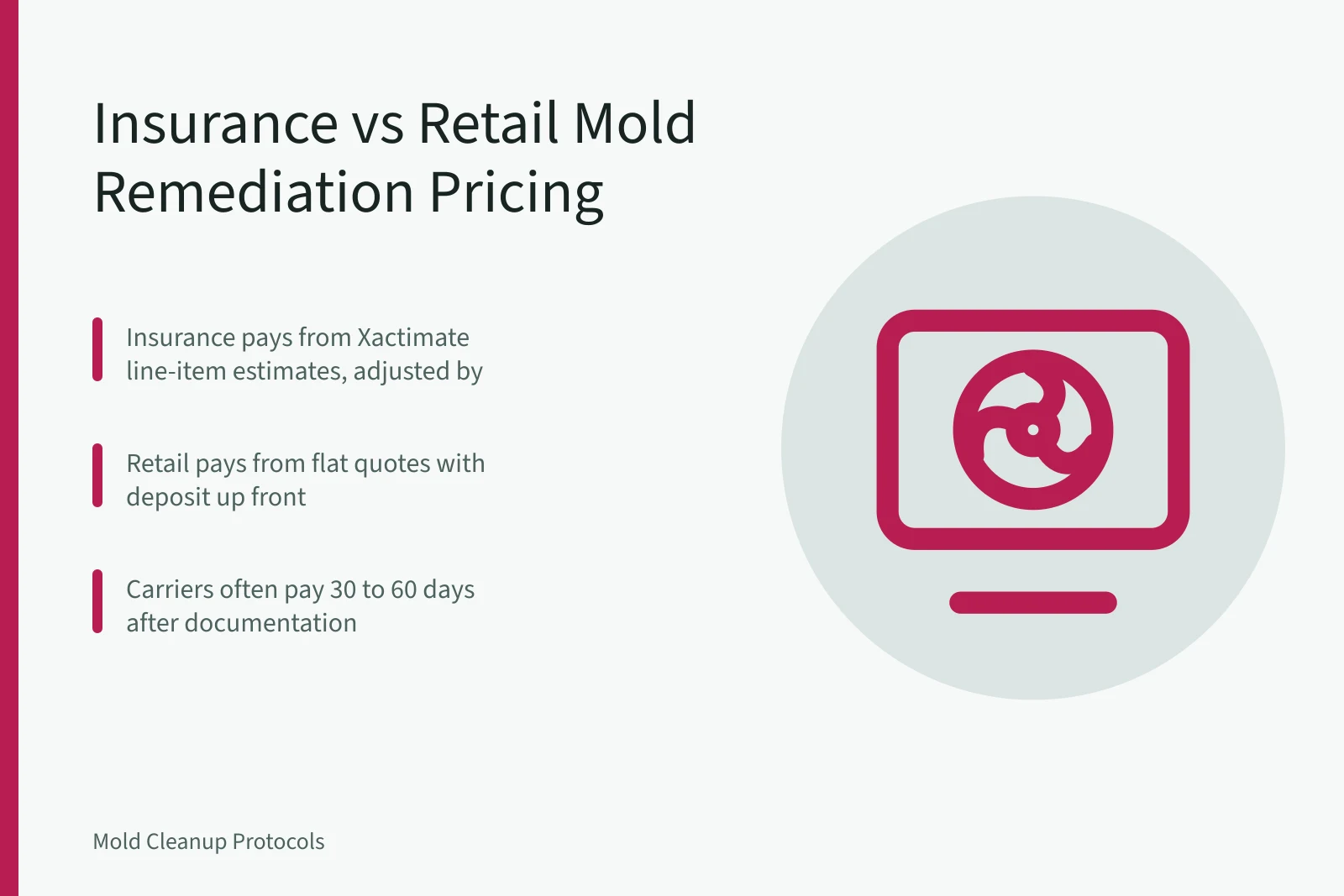
- Insurance work pays from a line-item estimate, usually written in Xactimate, then argued down by an adjuster. Retail work pays from a flat quote the homeowner accepts or rejects.
- The two models reward different skills. Insurance rewards documentation and negotiating; retail rewards sales speed and financing options.
- Insurance jobs often carry a lower gross margin on paper but steadier volume. Retail jobs can carry a higher margin and a longer sales cycle.
- Neither model protects you from scope creep. Both need a signed contract and a change-order process.
- Pick the mix that matches your office capacity, not the margin number alone.
What is being compared
Two ways a US mold remediation company gets paid. The first runs through a property insurer: the carrier assigns or the homeowner files a claim, and payment follows an estimate built in Xactimate, the estimating platform most US carriers and contractors use. The second is retail: the homeowner or landlord pays directly, usually against a flat quoted price.
These are not just different customers. They are different pricing systems, with different approval steps and different cash timing. A company can run both, but the margin math differs enough that owners should know which one they are actually running.
The criteria that matter
| Criterion | Insurance work | Retail work |
|---|---|---|
| How price is set | Line-item estimate in Xactimate, adjusted by carrier | Flat quote from your own cost build-up |
| Who approves scope | Adjuster, sometimes a third-party consultant | The property owner |
| Typical payment timing | Carrier pays after work and documentation, often 30 to 60 days | Deposit up front, balance on completion |
| Margin pressure | Unit prices set by pricing data and negotiation | Your markup, limited by local competition |
| Sales effort | Relationship with adjusters and agents | Direct consumer sales, often same-day |
| Change orders | Requires adjuster approval, can stall work | Owner signs, work continues |
Option by option
Insurance work. The estimate is written in Xactimate, where each task carries a unit price from a regional price list. Adjusters compare your line items against that list and against the scope they believe is justified. Getting paid well means documenting containment, removal, and clearance with photos, moisture readings, and a written protocol that matches a recognized standard such as ASTM E3024.
The margin lives in the details: how much material you remove, how many air scrubbers run, how long the job takes. Carriers also apply depreciation and deductibles, so the homeowner may owe a portion directly. That split is a common source of disputes.
Retail work. You build the price from your own labor, disposal, and equipment costs, then quote it flat. The owner compares two or three quotes and decides. Financing through a third party or a payment plan often closes the job. There is no adjuster to satisfy, but there is also no carrier guarantee that the scope is complete.
Retail pricing rewards a clear scope letter. A sample mold remediation quote shows how line items and exclusions can be laid out so the owner understands what the flat number covers.
Where each one wins
Insurance work is the right answer when you already have adjuster relationships, a full-time estimator, and cash to float 30 to 60 days of payroll. It suits companies that do water damage restoration and can handle volume.
Retail work is the right answer for a small owner-operator with limited office staff. One crew, one truck, and a same-week close beats waiting on a carrier for two months. It also fits jobs insurers often exclude, such as long-term seepage or maintenance-related growth.
The margin question is not which model pays more per job. It is which model you can actually run with the staff you have.
What none of them solve
Both models share one limitation: neither guarantees the scope is right. A carrier estimate can undercount hidden growth behind a wall. A retail quote can be accepted by an owner who then disputes the final bill. Neither system pays you for the extra day you spend on a job that was misjudged at the start.
Both also leave you exposed to the same labor rules. If your crews wear respirators, OSHA 1910.134 requires medical evaluation, fit testing, and training, and those hours belong in either estimate. Owners who want a hiring framework for that can read the employee training checklist.
The fix is procedural, not pricing. A signed contract with a clear scope, an exclusion list, and a change-order clause protects both models. Cornell's overview of contract law principles is a plain starting point for what those clauses need to do.
Example: the same job, two prices
A 400 square foot basement with visible growth on drywall and framing. Illustrative ranges only.
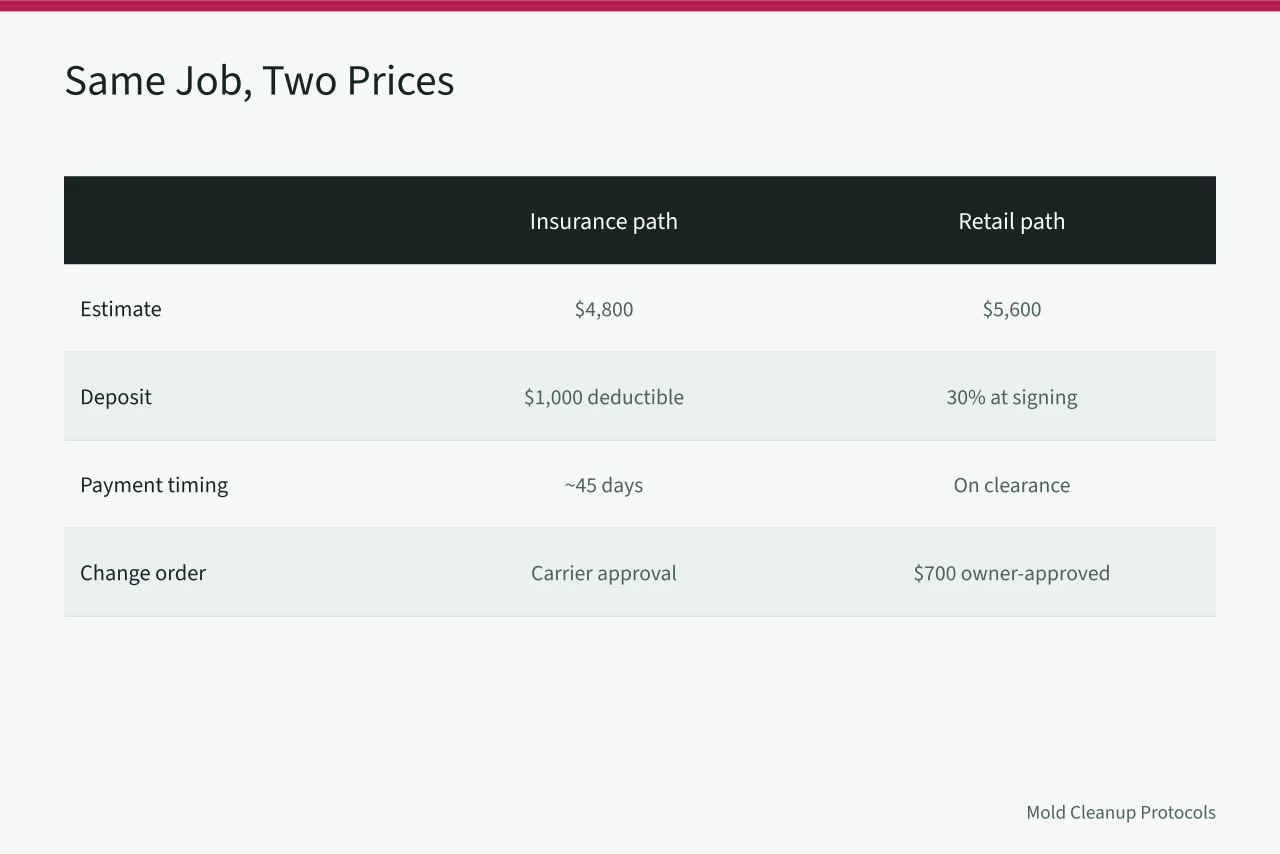
- Insurance path: Xactimate estimate near $4,800, depreciation withheld until completion, homeowner pays a $1,000 deductible, carrier releases the balance in about 45 days.
- Retail path: flat quote near $5,600, 30 percent deposit at signing, balance on clearance. Owner approves a $700 change order when the framing shows more growth.
The retail job collects faster and bills more. The insurance job repeats, because the carrier sends the next claim. Neither number is a benchmark; both depend on local labor rates and the size of the affected area.
Choosing your mix
Run the numbers on cash, not on margin alone. A 45 percent margin paid in 60 days is worse than a 35 percent margin paid in 10 days if you cannot make payroll in between. IRS Publication 535 covers how those business expenses are treated, which matters when you compare net results rather than gross.
Most established US firms run both and steer work by season. Insurance volume rises after storms and bursts. Retail fills the gaps. Owners who want more of the insurance side should start with referral relationships rather than cold calls to carriers.
Common questions
Is Xactimate required for insurance mold work? Most US carriers expect an estimate in a format they can compare against their pricing data, and Xactimate is the common platform. Some contractors submit their own format and negotiate from there, but it slows approval.
Can I charge more on retail jobs? Often yes, because there is no carrier price list capping unit prices. The limit is local competition and what the owner will finance. Document the scope so the higher number looks justified.
Do insurance jobs always pay less? Not always, but the unit prices are set by pricing data and negotiation rather than by you. The trade-off is volume and repeat work from adjusters and agents.
What if the owner disputes the final bill? A signed contract with a change-order clause and a written clearance process is the main defense. A complaint handling process helps you resolve it before it becomes a legal cost.