Guides
Reading mold remediation trends before they reach your books in 2027
Mold remediation demand is shaped by aging and tighter buildings, concentrated weather events, professional payers, and evidence becoming the product.
What to take away
- No forecasts or market figures appear here. What follows are structural mechanisms that are already visible and that change how the work is bought and delivered.
- Demand in this trade is created by buildings, weather and money, in that order.
- The buyer is professionalizing. More work arrives through managers, adjusters and referral trades, and each of them wants documentation rather than reassurance.
- The biggest operational shift is that evidence has become the product as much as the cleanup is.
General discussion of durable drivers, not a prediction. Nothing here should be treated as a market forecast, and no figure is stated because none can be verified from a page.
Buildings: the stock keeps getting older, and tighter
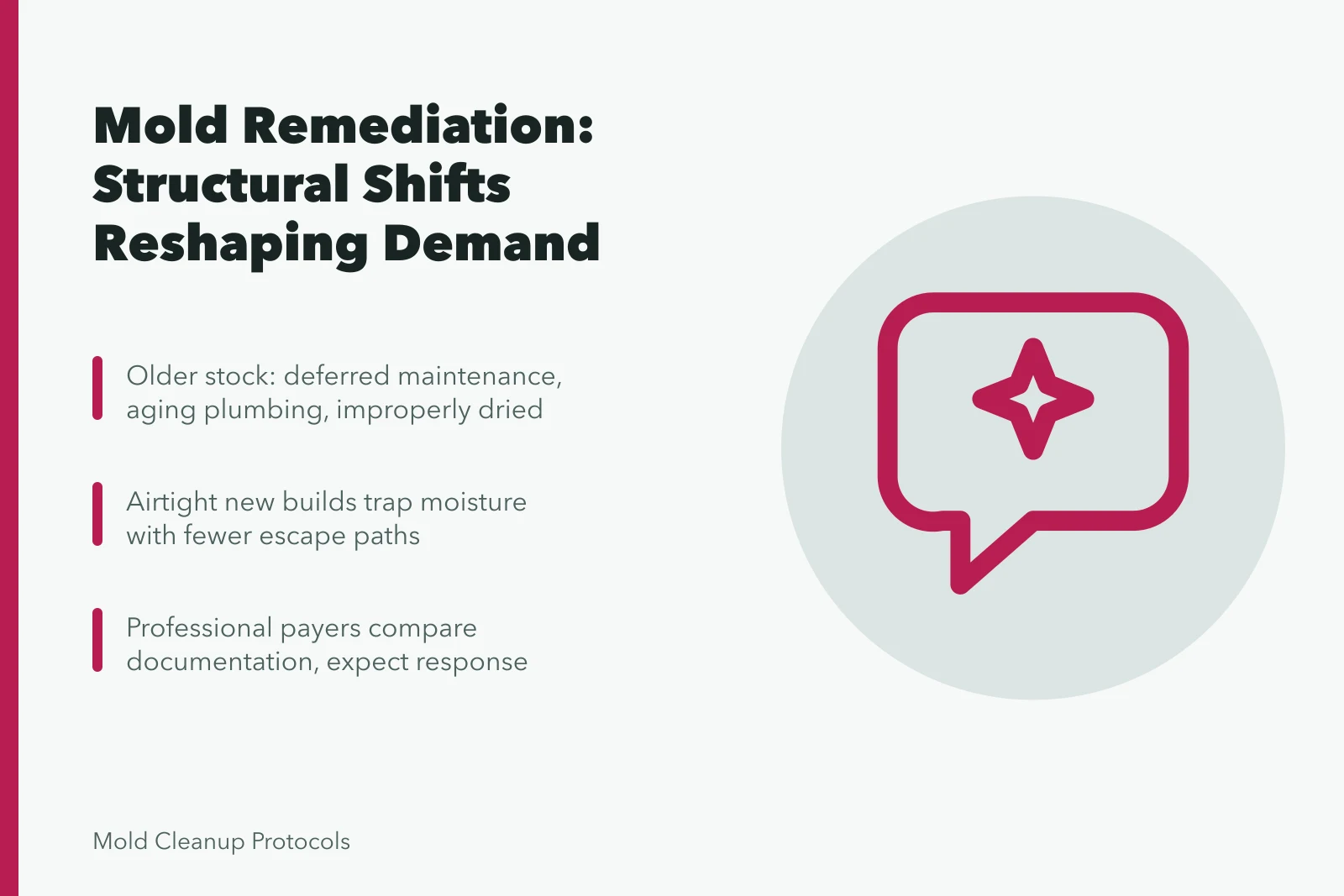
Two building trends push in the same direction. Older housing stock accumulates deferred maintenance, aging plumbing and previously repaired water damage that was never dried properly. Newer construction is built far more airtight, which is good for energy and unforgiving of moisture that gets in, because it has fewer paths out.
For an operator that means two distinct job types with different methods, and a growing need to explain to customers why a modern house behaves differently from the one they grew up in.
Weather: severity rather than frequency
You do not need a forecast to observe the operational consequence. Work arrives in concentrated bursts, and firms are increasingly judged on their ability to say no gracefully and to sequence a queue. Two capabilities follow:
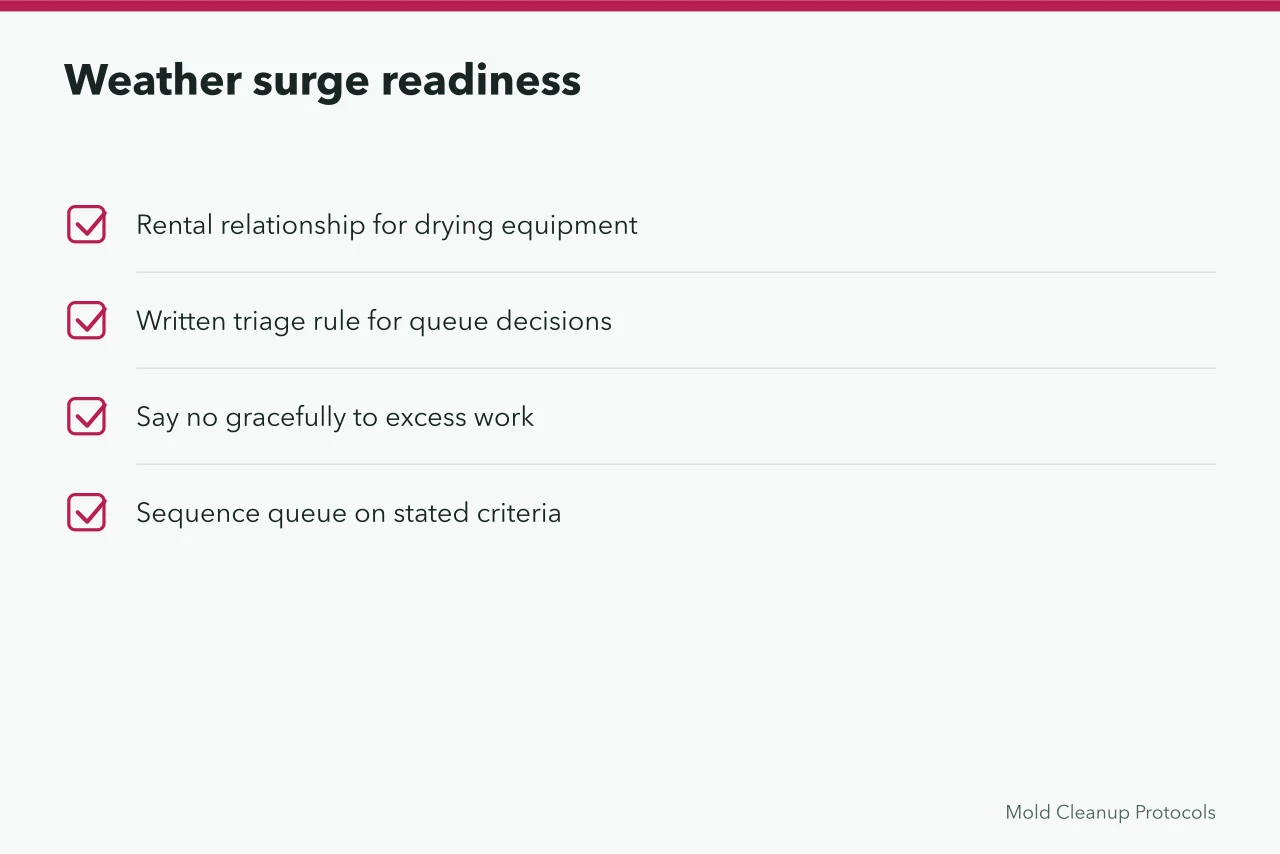
- A rental relationship for drying equipment that survives a regional event, when everyone wants the same units.
- A written triage rule, so that queue decisions are made on stated criteria rather than by whoever shouts loudest.
The fleet question this creates is worked through in equipment and setup.
Money: the payer is changing
The share of work that arrives through a professional intermediary keeps growing: property managers, institutional landlords, independent adjusters, and restoration generalists subcontracting the mold portion. These buyers behave differently from homeowners.
- They compare documentation, not just price.
- They expect a response standard and will measure it.
- They pay more slowly and more reliably.
- They consolidate. Losing one costs more than losing ten homeowners.
That shifts what a firm needs to invest in. Not advertising, but the file quality and response discipline described in mold remediation service quality.
Evidence has become part of the product
Verification, moisture logging over time and a legible closeout pack were once good practice. They are increasingly the thing being bought, because the intermediary needs to hand something to someone else: a tenant, an owner, an insurer, a buyer.
The technical expectations behind that file have not changed. The EPA mold cleanup collection still holds the guidance the work is judged against, including the worker and employer guide to hazards and recommended controls. What has changed is that somebody now reads the file.
Labor: the constraint that is not going away
Recruiting for physical work performed in a respirator has grown harder for years. The prerequisites before someone may enter a work area add weeks to every hire.
Check what roles cost in your own market with the BLS occupational employment and wage tables, not last year's assumption. Expect the gap between what you planned to pay and what you must pay for qualified people to keep widening.
The practical response is not a higher rate alone. It is the schedule, the equipment condition and the progression path covered in hiring and training.
Regulation: uneven, and moving
Some states have added or tightened mold licensing, others have not, and the separation of assessment from remediation continues to receive attention. There is no national direction to follow, which is exactly why an annual review of your own jurisdiction is the only reliable approach. The method is in licensing and compliance.
For a firm considering new territory, the SBA business guide covers the registration layering that varies with it.
What this means for a service menu
- Documentation and verification coordination are worth selling as named services, not absorbing.
- Portfolio monitoring agreements smooth demand that is otherwise event-driven.
- Assessment-only work becomes more valuable where separation rules tighten.
- Reconstruction becomes harder to bolt on as licensing gets more attention.
Reflect that in the definitions in mold remediation services and packages rather than in your advertising, since a service you cannot deliver consistently is worse than one you never offered.
The comparison that matters
| What to compare | Why it matters for a mold remediation business | Common mistake |
|---|---|---|
| Whether it suits the actual work | A tool built for another trade fights the remediation job every day | Choosing on features nobody will use |
| Support when it breaks | Local service beats a better model far away | Assuming the seller services what they sell |
| Cost over the whole life | Financing terms change the real cost | Comparing sticker prices |
| Fit with how the crew works | Adoption decides the value | Skipping the trial period |
| Exit and switching cost | The homeowner or property manager notices a disruptive switch | No export of records |
Common questions
Is demand for mold remediation growing?
Nobody can tell you that reliably at a national level, and it would not help you if they could. What matters is your own metropolitan area, its building stock and its payer mix, which you can research directly.
Should I invest ahead of a trend?
Invest ahead of a constraint you can measure, such as equipment utilization or a documented pattern of turned-away work. Investing ahead of a forecast is speculation with your own payroll.
Will remote inspection tools replace site visits?
They change triage rather than replace the work. A photograph does not tell you what a meter tells you, and nothing about a video call gets a wall open.
What is the safest bet for a small firm?
Getting better at the evidence. It costs little, it is what the growing buyer segment is actually purchasing, and it is durable regardless of which way any of the above moves.